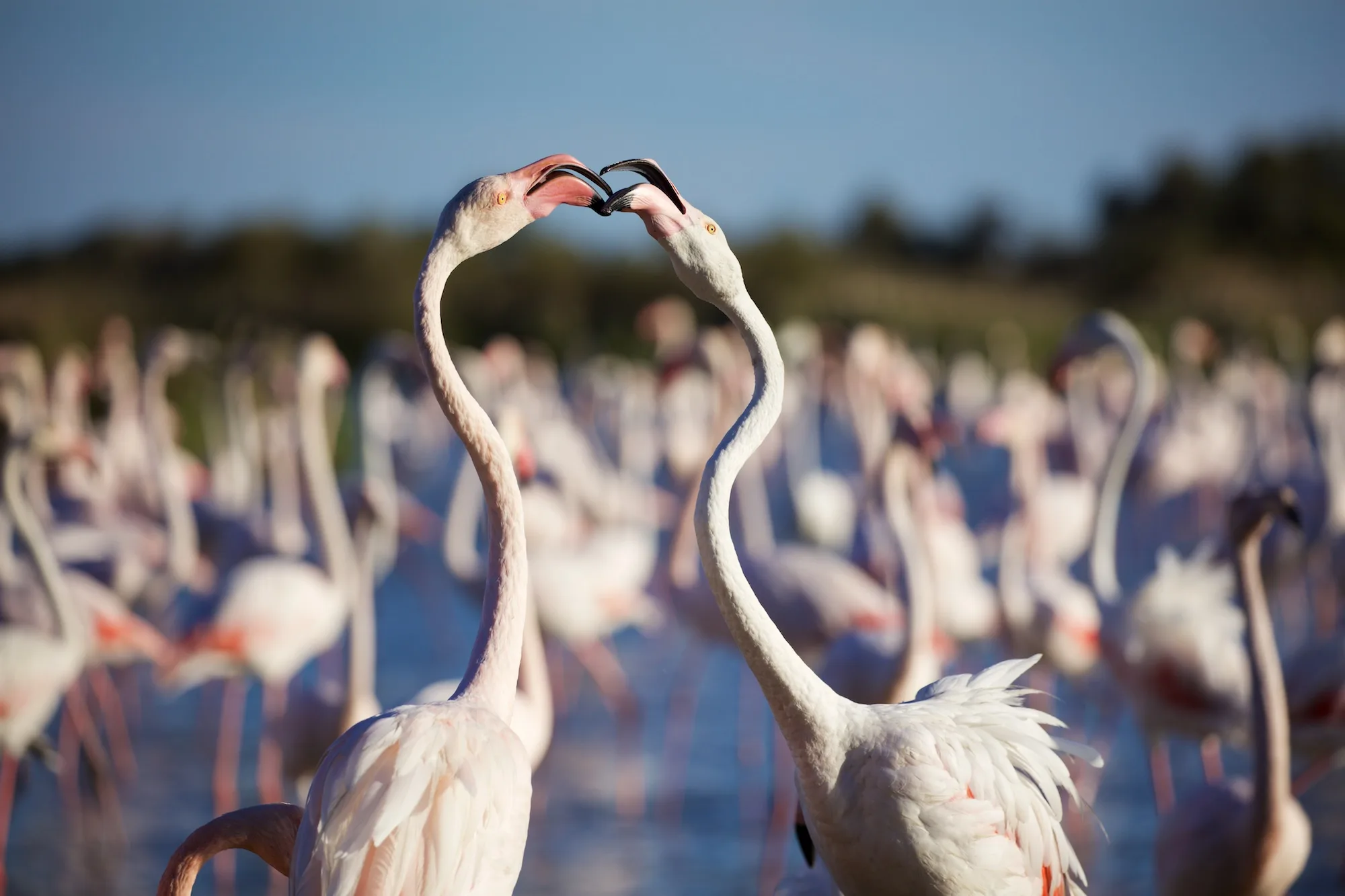
Watching flamingos on the Thau lagoon
The first time I saw flamingos on the Etang de Thau, I could hardly believe it. You associate them with the Camargue, not the Languedoc. Yet here they are, in dozens, sometimes hundreds, on the lagoons of the Herault. And it has been going on for years.
From Florensac, the Etang de Thau is a fifteen-minute drive. You can watch the flamingos without special preparation, without a guide, without expensive equipment. You just need to know where to go and when.
Where to find them
The Villeroy salt pans (Sete)
This is the best spot in the area. The former salt pans, between Sete and Marseillan, form shallow basins that flamingos love. You can see them from the road, but a footpath lets you get closer without disturbing them.
The flamingos are often there early in the morning, when it’s quiet. In summer they tend to move to the deeper sections. In winter and spring they’re clearly visible near the banks.
- Access: road between Sete and Marseillan, car park at the salt pans
- Distance from Florensac: 20 min by car
The Etang de Thau, Marseillan side
The lagoon shore between Marseillan-Plage and the village of Marseillan offers good vantage points. Park at Marseillan harbour and walk along the lagoon. The flamingos stand in the shallows, often 100 to 200 metres from the shore.
- Access: Marseillan harbour, then coastal path heading east
- Distance from Florensac: 15 min by car
The Bagnas nature reserve
The Bagnas national nature reserve, between Agde and Marseillan, is a classified site. It’s a lagoon of mixed fresh and salt water that hosts dozens of bird species, including flamingos. Access is regulated: you enter via a path lined with observation screens.
This is the most “wild” site on the list. You’ll also see grey herons, little egrets, ducks and coots. ADENA (the local nature protection association) sometimes organises free guided outings.
- Access: car park on the D51 between Agde and Marseillan. Signposted path
- Distance from Florensac: 15 min by car
- Hours: free access during the day, no lighting in the evening
The Vendres and Lespignan lagoons (further afield)
For keen birdwatchers, the lagoons at Vendres and Lespignan, south-west of Beziers, host large colonies. It’s further from Florensac (40 min), but there are fewer visitors and often more flamingos.
When to watch
Flamingos are present in the Herault almost year-round. But the best times:
Autumn (October-November): the colonies are at full strength, the birds gather before winter. This is the best period for large groups.
Winter (December-February): the flamingos stay on the Herault lagoons, which are milder than the Camargue. Fewer birds but easier to observe (less vegetation, fewer visitors).
Spring (March-May): the birds begin nesting. The colours are brighter (the pink intensifies with their diet of brine shrimp and algae).
Summer: the flamingos are around but move more. The heat creates mirages on the water. Go early in the morning.
Tips for birdwatching
Binoculars: essential. With the naked eye, you see pink blurs. With 8x42 or 10x42 binoculars, you can make out plumage details, legs and beaks.
Distance: stay at least 100 metres away. Flamingos are wary. If the group becomes restless or starts to walk, you’re too close. Step back.
Noise: speak quietly, no music, no slamming car doors. It’s basic but it makes all the difference.
Light: early morning and evening give the best light for photographs. The pink of the flamingos comes through better in warm light. At midday, everything is washed out and flat.
Clothing: neutral colours (no bright red, no dazzling white). Birds react to strong contrasts.
Why are they here?
The flamingos of the Herault are not lost. They belong to a Mediterranean population that moves between the Camargue, Spain, Sardinia and North Africa. The Herault lagoons give them what they need: shallow waters rich in artemia (brine shrimp) and algae, few predators and peace.
Our family has been here for over two hundred years. We’ve seen the landscape change, vineyards replace marshland, and marshland return in the form of protected reserves. The flamingos benefit from that protection. Before the 1990s, you almost never saw them in the Herault. Today it’s become normal. My brothers, who work in the vineyards around the lagoon, see them fly past every day.
Other birds to see
The Herault lagoons are not just about flamingos. You can also spot:
- Grey heron: present year-round, often standing motionless by the water
- Little egret: white, slender, elegant. Common on the Thau shoreline
- Avocet: distinctive upturned beak, black and white plumage. Present in winter
- Kingfisher: small, fast, electric blue. Hard to see, easy to hear
- Cormorants: perched on the posts of the oyster beds, wings outstretched to dry
Practical information
- Best spot: Villeroy salt pans between Sete and Marseillan (20 min from Florensac)
- Best period: October-November for large groups, year-round otherwise
- Equipment: binoculars strongly recommended, closed shoes (muddy paths)
- Guided visits: ADENA (Bagnas reserve), free outings in season. Details at the Agde tourist office
- App: BirdNET to identify birdsong on site
The flamingos are a fifteen-minute drive from our B&B. You head out in the morning, watch for a while and come back for the rest of the day. Florensac is well placed for that. Discover our rooms.